How Casino Imagery Travels Through Nhà Bè City Stories
Learn how casino imagery travels through Nhà Bè city stories, so you can distinguish a fictional venue from a mood and read each scene more carefully.
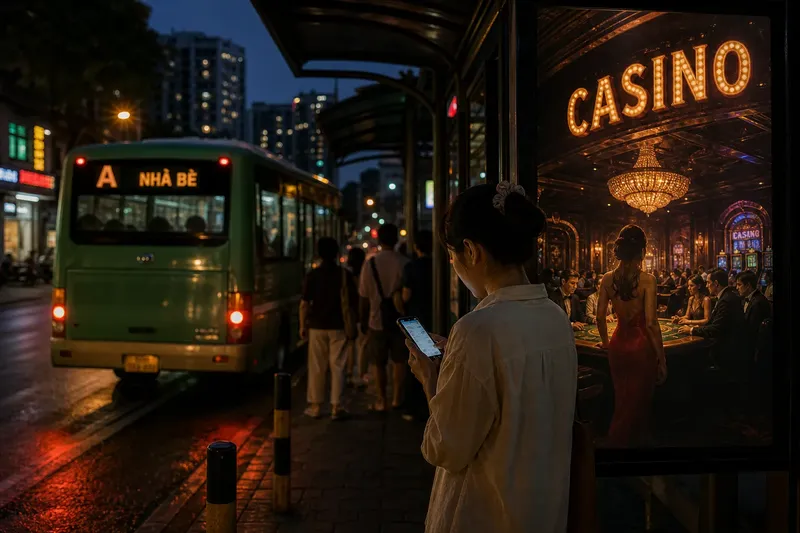
A Nhà Bè bus pulls away from a stop as a passenger scrolls past a film poster bearing the word “casino”. That small glimpse is enough to raise a useful question: is the story pointing to a venue, or using casino imagery to shape the mood of a city scene?
What does casino imagery mean in a city story?
The word may name a gambling venue, suggest spectacle and chance, or do both at once. Look at what happens in the scene: a place where characters meet, a room arranged around a performance and a setting focused on risk can all hold a crowd, but the action gives each a different meaning.
There is little value in asking a single scene to explain the word’s history. Without a reliable linguistic source, it is clearer to read the details on the page than to claim a precise origin or route for the term.
Notice who enters, what they do and what catches their attention. A sign alone may introduce a setting; practical details and character actions show whether the casino is also central to the story.
How does casino imagery travel through Nhà Bè?
During an ordinary journey, a casino image might appear on a poster, screen or passing conversation. The image reaches the reader before any physical venue enters the picture, making the commute part of the way the idea travels through city life.
This is a way of reading culture, not a claim about Nhà Bè’s venue history. A film may use bright signage or a crowded interior to suggest glamour or uncertainty, but its imagery cannot establish what a neighbourhood contains, how residents use its public spaces or what its history has been.
Keep the distinction clear: the journey gives the image a local setting, while the story supplies its fictional one. Neither should be mistaken for documentation of a real place.
What should you notice in a casino scene?
Follow the scene from its first cue to its exit. Each observation can guide a modest reading without asking a sign or decorative detail to carry more meaning than the story gives it.
- Check the first cue. If “casino” appears only on a poster, then treat it as a label and look for more context; if the scene describes the room and its use, then read those details before deciding what kind of place it is.
- Check what visitors do. If they meet, watch, perform or pass through, then let that action guide your reading; if their actions remain unclear, then avoid assigning the venue a more specific role than the text supports.
- Check whose attention the scene follows. If it stays with one visitor, then consider the room through that person’s aims; if it shifts among the crowd, then read for the collective event instead.
- Check what is at stake. If the action centres on money or chance, then follow those concerns; if it centres on status, escape or an encounter, then read that emphasis rather than assuming gambling is the point.
- Check what changes by the exit. If a character leaves with a changed decision or relationship, then treat the setting as part of the plot; if nothing changes, then read it mainly as atmosphere.
- Check whether the scene names a real place. If it provides verifiable details, then assess those claims separately; if it offers only stylised imagery, then treat it as fiction rather than local documentation.
Imagine an invented scene that begins with a visitor stepping from a crowded street into a casino-themed room, hoping to meet an old friend. The visitor follows the sound of a performance and finds the friend watching from across the room; because the scene follows that search, the expected reunion becomes a delayed conversation. The observable result is an interruption that shifts the story towards public spectacle, not evidence about a real venue.
It is not worth treating every flashing sign or polished surface as a coded historical clue. A detail may simply set a mood; give it greater weight only if the characters’ actions or the scene’s changes support that reading.
Which questions help you read casino imagery?
Does casino always mean a gambling venue?
No. In a story, the word may name a venue, evoke a mood or do both. Follow the characters’ actions and the details the scene supplies.
Why do stories use casino settings?
A casino can bring strangers, spectacle and private aims into one scene. That mix can set up an encounter or interruption without making symbolism do all the work.
Does a fictional casino describe a real place?
Not by itself. Fiction may borrow visual or social cues for atmosphere; claims about an actual location need separate, reliable support.
How can I tell whether casino means a place or a mood?
Look for details about where people are and what they do. If the scene mainly evokes glamour, chance or spectacle, mood may matter more than venue; if it gives both practical action and atmosphere, both meanings are at work.
What does the image add to the city story?
Casino imagery can turn a venue into a meeting place, a source of spectacle or a sign of uncertainty. Reading the scene through its actions helps separate those roles from the city beyond the screen.
Next time the word appears during a journey through Nhà Bè, notice whether the story asks you to watch the room, follow the crowd or wait for a meeting. That small distinction makes it easier to see how casino imagery travels through city stories without confusing fiction with a local record.