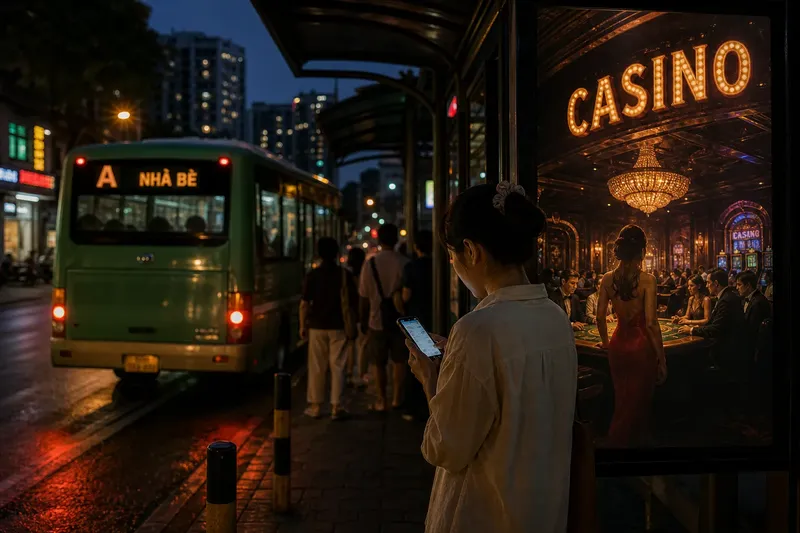
How Casino Culture Appears Along Nhà Bè’s Commuter Routes
See how casino imagery travels through Nhà Bè’s commuter routes, and learn to distinguish a passing sign or screen from the wider life of the street.
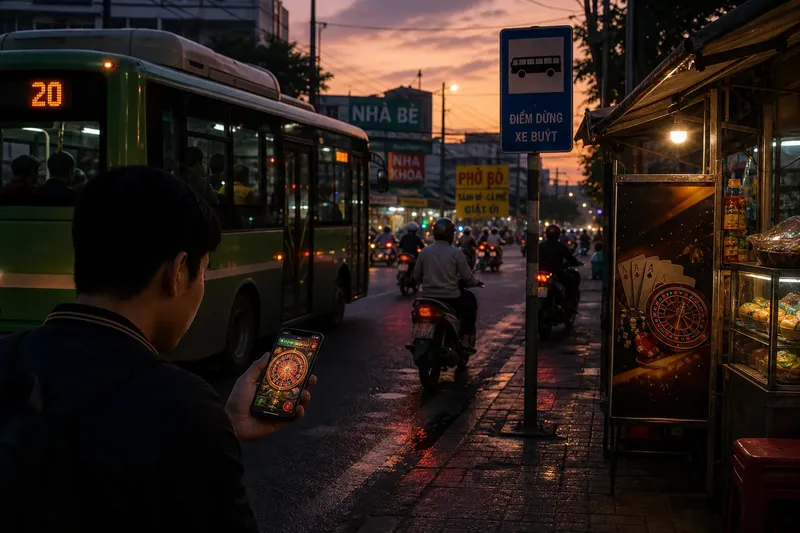
A bus pauses near a junction in Nhà Bè; beside the road, a phone screen flashes a casino-style game before its owner puts it away. Casino culture on commuter routes can arrive in moments like this, woven among shop signs, traffic and the ordinary business of getting home.
That brief glimpse tells you something specific: an image of chance or gaming has appeared in a public setting. It does not tell you who uses the game, what they think of it, or how common it is. Treating those distinctions carefully makes the subject more interesting, not less.
Where might casino culture appear on a daily route?
The word “casino” can travel without a casino building on the street. A commuter might encounter gaming imagery on a screen, a printed advertisement, a shop display or a conversation overheard at a stop. The forms vary, and some references may be ambiguous until viewed up close.
Along a route through Nhà Bè, the surrounding scene matters. A bright graphic beside a food stall shares space with signs for everyday services; a phone game is seen amid the wait for a ride. These settings show how entertainment imagery enters the texture of a journey, but not what the people nearby make of it.
What can a passing image tell you?
Start with what is directly visible: a card motif, a roulette-style wheel, a brand name, or a screen showing a game. Then separate that observation from any guess about its purpose or audience. A passing view may not reveal whether an image is an advertisement, a game interface or a decorative reference.
This distinction is especially useful with casino culture, which can carry different meanings for different people. One person may see a familiar entertainment symbol; another may read it as a warning about risk. A commuter cannot settle that difference from a glance.
How does the route shape what you notice?
A bus window, a stop and a road junction each offer a different kind of encounter. A sign may be visible only briefly as the bus moves; waiting at a stop may leave more time to read it, though people and vehicles can still block the view. From a motorbike passenger seat, attention belongs first to the journey, so trying to inspect a display closely is a poor trade.
Sound can carry references too: a conversation, an advert from a nearby speaker, or a game effect on a phone. The source and context may be hard to identify in passing. Do not turn a fragment of overheard talk into a claim about the speaker or the neighbourhood.
How can you observe without over-reading the scene?
Use a simple distinction: record the visible or audible detail, then mark what remains unknown. For instance, “a screen showed a card game” is an observation; “the person was gambling” is an inference that the scene may not support.
- If a sign clearly names a casino or game, note the wording; if it is partly obscured, treat the identification as uncertain rather than filling in missing text.
- If an image contains recognisable gaming symbols, describe those symbols; if they could also be decorative, avoid assigning them a definite purpose.
- If a screen is visible only for a moment, record that it displayed a game-like image; if the activity is unclear, do not infer how it was being used.
- If a reference appears beside ordinary shop signs, note that shared setting; if you cannot tell who it addresses, do not assume a particular audience.
- If someone mentions a game in conversation, distinguish the words you actually heard; if the context is incomplete, leave the speaker’s meaning open.
- If traffic or a crowd blocks the view, accept that the detail is unavailable; if a clearer view would require leaning or distracting the driver, let it go.
Not every sighting deserves a photograph, a search or a theory. In particular, it is not worth craning across a crowded vehicle or filming strangers to satisfy curiosity. Safe travel and other people’s privacy matter more than a tidier account of a passing scene.
What questions do commuters ask about casino imagery?
Does seeing casino imagery mean there is a casino nearby?
No. A game reference on a screen or sign does not establish that a casino is close by, or even identify the source of the image. The location and context would need separate confirmation.
Can a passing advert show who is interested in gambling?
It can show that an advert or image was present, but not who noticed it or what they thought. A person’s interest cannot be read reliably from a brief glimpse.
Why can the same gaming symbol mean different things?
Symbols such as cards, dice or spinning wheels can be used in games, advertising and decoration. Their meaning depends on context that a commuter may not be able to see.
How should I describe an uncertain sighting?
Use plain, bounded language: “a screen showed card-like graphics” or “a sign included a roulette-style image”. If the view was unclear, say so rather than presenting an interpretation as fact.
What does a careful account of the route look like?
Say you are waiting at a Nhà Bè bus stop and notice a poster with a wheel graphic and a partly hidden word. First, note the visible details without supplying the missing letters; next, check whether the poster’s placement or surrounding text clarifies what it promotes, if you can do so safely and without approaching private property. The resulting account might be: “A poster near the stop showed a wheel graphic; its wording was partly blocked, so its subject was unclear.” That answer preserves the sighting while leaving its meaning unresolved.
Casino culture on commuter routes is not a census of local habits. It is a way to notice where gaming language and imagery surface in shared spaces, and to keep observation distinct from assumption. On the next journey, a precise description of one sign or screen is more useful than a sweeping claim about the people passing it.