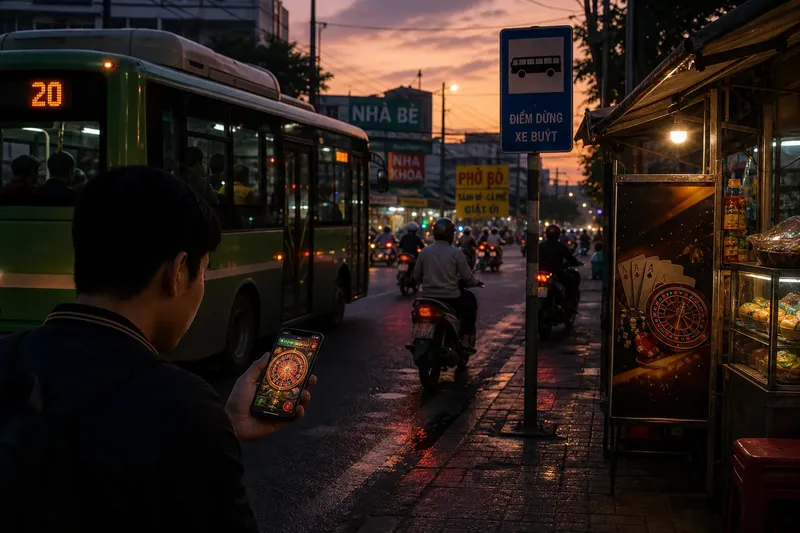
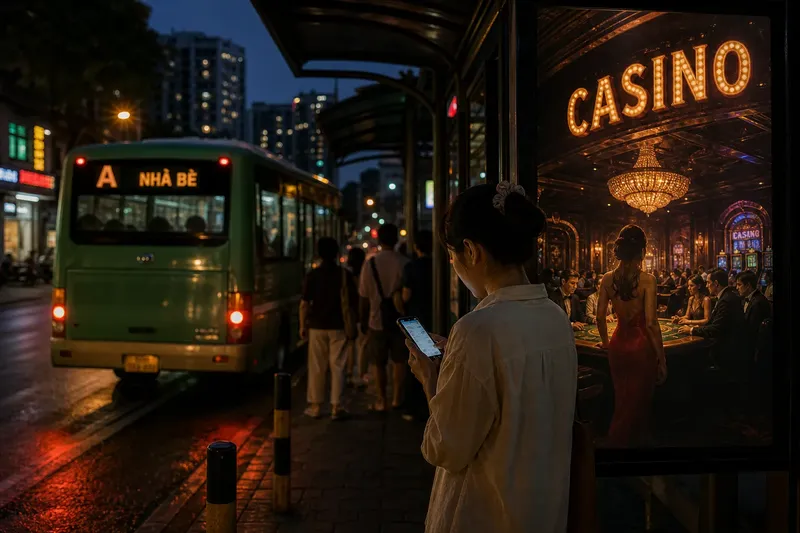
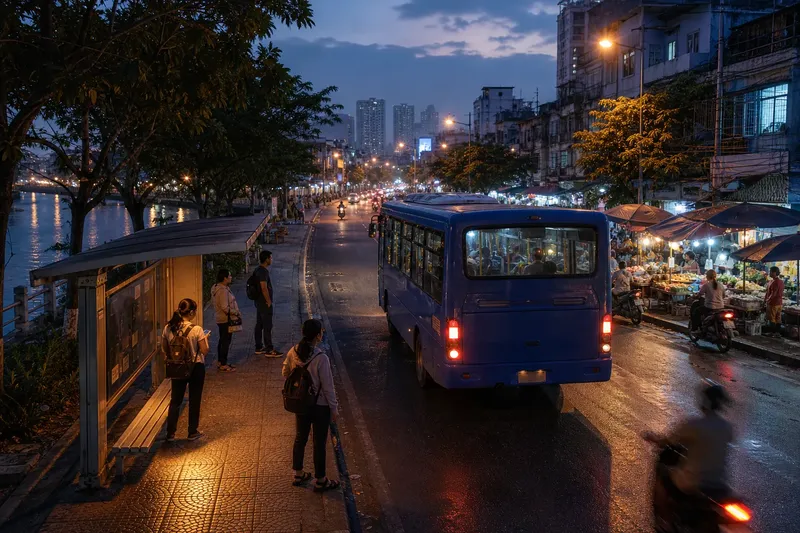
Casino Signs Along Nhà Bè’s Commuter Routes
Casino signs along Nhà Bè’s commuter routes reveal how commercial fantasy shares public space; learn to read the imagery without letting it choose your destination.
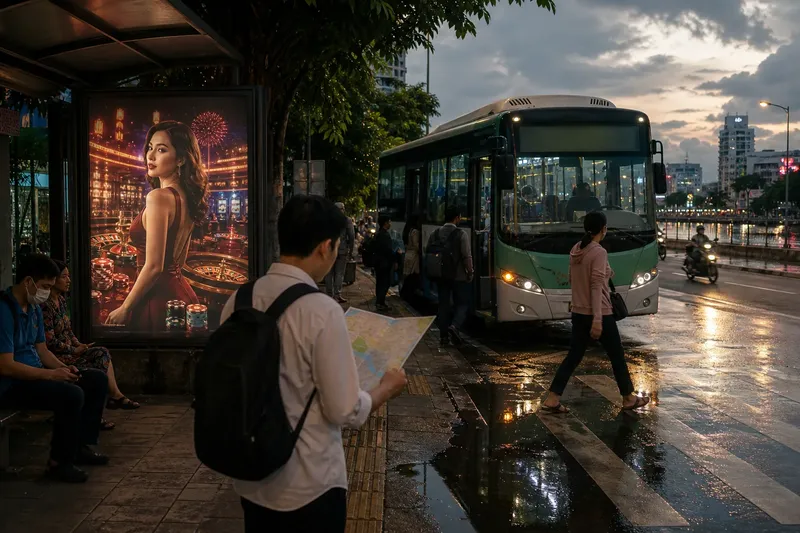
A bus pauses beside a bright casino advert on a Nhà Bè road, while commuters step around a puddle and check the crossing ahead. Casino signs along Nhà Bè’s commuter routes are more than directions to a venue: they bring an elsewhere of velvet, lights and easy fortune into the ordinary business of getting home.
What does a casino sign add to an ordinary journey?
The sign interrupts the route with a promise of escape. Its imagery can turn a wall, bus shelter or passing vehicle into a small stage, set against the practical surroundings of shops, crossings and waiting passengers.
That contrast is part of the appeal. The advert may suggest glamour, but the street around it remains a shared place used for work, errands and travel. Reading both at once reveals how casino culture travels beyond a venue: through images encountered by people who may never intend to enter one.
How does the image shape a sense of place?
A casino advert is designed to catch the eye, so its version of the city can feel more vivid than the blocks around it. Yet a commuter’s sense of place is also made from less theatrical details: the familiar bus stop, a shaded pavement, a bridge crossing or a shopkeeper opening the shutters.
Neither view cancels the other. The advert offers a commercial fantasy; the journey supplies the lived setting in which that fantasy appears. It is not worth trying to decode every slogan or treat each sign as a clue to the neighbourhood. Notice the image, then ask what the surrounding public space is actually doing.
How can you read the advert without following its script?
A useful way to look is to separate the sign’s invitation from the choices you have already made. Check the route, your destination and the conditions around you; an advert’s brightness does not make it a useful landmark or a reason to change plans.
- Check whether the sign names a venue or merely uses casino imagery; if it names a venue, treat it as commercial information and verify the location separately, but if it does not, read it as an image rather than a direction.
- Check whether the advert is beside your intended route; if it is, continue towards your planned stop, but if it is not, do not detour unless the venue genuinely fits your plans.
- Check whether a map or current transport information agrees with the sign’s implied location; if it does, use the verified route, but if it does not, follow reliable route information rather than the advert.
- Check whether you are stopped somewhere safe before looking closely; if you are, take in the design, but if you are crossing or moving through a crowd, put the phone away and look later.
- Check what the advert leaves out, such as the ordinary street around the venue; if the surrounding conditions matter to your journey, assess those directly, but if they do not, keep your attention on the next route decision.
- Check whether the image is changing your mood or destination choice; if it is, pause and compare that impulse with your original plans, but if it is not, carry on without giving the sign extra weight.
What do readers ask about casino signs on Nhà Bè routes?
Are casino adverts directions to a nearby venue?
Not necessarily. An advert can promote a brand or event without establishing how close a venue is, so check a current map or official venue information before relying on it.
Why do casino images feel different from the street around them?
They often use carefully composed scenes of spectacle and escape, while a commuter sees the unedited pavement, traffic and daily errands. The gap between those images is itself a revealing part of the streetscape.
Should a casino advert change my route?
Only if the destination independently suits your plans and you have checked practical details. A striking sign alone is not a reason to leave your route.
How can I notice public-space advertising safely?
Look while waiting at a stop or standing away from the flow of pedestrians. Keep your attention on crossings and moving traffic when you are walking.
What might this look like on a commute?
Imagine a commuter starting at a Nhà Bè bus stop with one planned destination: a riverside public space. For this invented scenario, the starting inputs are a paper map showing the intended streets, a phone with a transit app, one bus connection listed in the app and a casino advert beside the road. First, the commuter checks the map and confirms that the planned route crosses a canal. Next, they compare the app’s bus sequence with the posted stop information and decide to take the listed connection because the details agree. After leaving the bus, they follow signs towards the riverside space; the casino advert points elsewhere, so they do not detour. The observable result is a journey that stays aligned with the chosen destination, while the advert remains something noticed along the way rather than an instruction.
Casino signs along Nhà Bè’s commuter routes are easiest to understand when set beside the everyday landscape they interrupt. Their imagery can tell you something about commercial hopes and urban attention, but the more useful question is what the street asks of you now: wait, cross, make room, or continue towards the place you chose.